
A person’s mindset is their attitude or way of thinking about something. It influences how they approach challenges and opportunities, and can have a profound impact on their success and happiness.
There are many different types of mindsets, and they can vary widely depending on an individual’s personal beliefs, experiences, and values. Some examples of different mindsets might include a competitive mindset, a collaborative mindset, a creative mindset, a risk-taking mindset, or a solution-focused mindset.
Regardless of the specific type of mindset, it is generally understood to be a mental framework or set of beliefs that determine how an individual thinks, feels, and behaves in a given situation. A person’s mindset can shape their perspective, values, and goals, and it can have a significant impact on their success and happiness.
In addition to influencing an individual’s approach to challenges and opportunities, a mindset can also influence their overall outlook on life. For example, someone with a positive mindset may be more likely to see the good in situations and people and may be more resilient in the face of challenges. On the other hand, someone with a negative mindset may be more likely to focus on the negative aspects of situations and may be more prone to feeling discouraged or defeated.
Mindsets can also be influenced by external factors, such as the culture and environment in which an individual grows up, their education and experiences, and the people they surround themselves with. For example, an individual who grows up in a supportive and positive environment may be more likely to develop a growth mindset, while someone who grows up in a negative or critical environment may be more likely to develop a fixed mindset.
Simply, a mindset is an individual’s attitude or way of thinking about something. It influences how they approach challenges and opportunities, and can have a significant impact on their success and happiness. Mindsets can be influenced by external factors such as culture, environment, and experiences, and they can also vary widely depending on an individual’s personal beliefs, values, and goals. These will then be reinforced with habits.
Growth Mindset
Carol Dweck is a psychology professor at Stanford University who is known for her research on mindset and its impact on motivation, learning, and achievement. Dweck has developed the concept of a growth mindset, which is a way of thinking that believes that abilities and talents can be developed and improved through effort and learning.
According to Dweck, individuals with a growth mindset view challenges and setbacks as opportunities to learn and grow, rather than as threats to their self-worth or abilities. They are more likely to embrace challenges and persevere in the face of setbacks, and they are more open to seeking out feedback and learning from their mistakes.
Dweck’s research has shown that a growth mindset can have a positive impact on motivation, learning, and achievement. Individuals with a growth mindset are more likely to be motivated to learn and improve, and they are more likely to achieve success in their personal and professional lives.
In contrast, individuals with a fixed mindset, which is a way of thinking that believes that abilities and talents are predetermined and cannot be changed, may be less motivated to learn and grow, and may be more likely to give up in the face of challenges or setbacks.
There are two main types of mindset: a fixed mindset and a growth mindset. People with a fixed mindset believe that their abilities and talents are predetermined and cannot be changed. They tend to avoid challenges and may give up easily when faced with obstacles, because they believe that failure is a reflection of their inherent abilities.
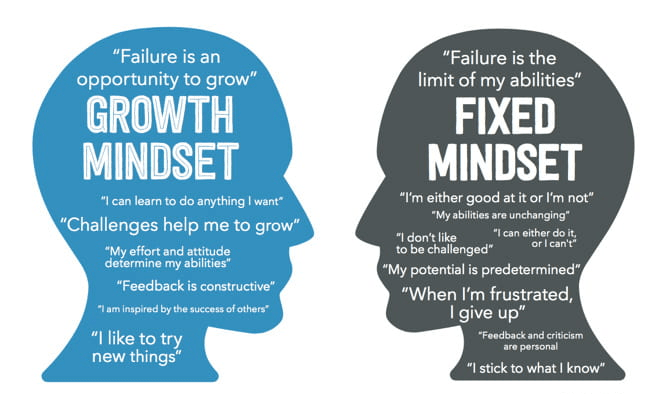
On the other hand, people with a growth mindset believe that their abilities and talents can be developed and improved through effort and learning. They are more likely to take on challenges and persevere in the face of setbacks, because they see failure as an opportunity to learn and grow.
Having a growth mindset can be beneficial in many aspects of life. It can help individuals develop a love of learning and a willingness to take on new challenges. It can also foster resilience and determination, which are important qualities for achieving success in any field.
In addition to the individual benefits of a growth mindset, it can also have a positive impact on teams and organizations. A growth mindset can foster collaboration and innovation, as well as a culture of continuous learning and improvement.
To develop a growth mindset, individuals can try to embrace challenges and view them as opportunities to learn and grow. They can also strive to learn from their mistakes and failures, and seek out feedback and support from others.
Having a growth mindset is an important aspect of personal and professional development. It can help individuals overcome challenges and achieve success, and it can also benefit teams and organizations. By embracing a growth mindset, individuals can foster a love of learning and a willingness to take on new challenges, which can help them to achieve their goals and reach their full potential.
Dweck’s research on mindset has been influential in the field of education, and has led to the development of strategies and approaches that can help individuals to develop a growth mindset. These include praising effort and learning, rather than innate ability, and providing opportunities for students to take on challenges and learn from their mistakes.
You can watch her TED talk here
Building your Growth Mindset
In order to cultivate a growth mindset, it is important to take a proactive approach. This may involve setting specific goals and creating a plan to achieve them. It may also involve seeking out new learning opportunities, such as taking a course or attending a workshop, or engaging in regular self-reflection to identify areas for improvement.
Another important aspect of developing a growth mindset is to surround oneself with people who also have a growth mindset. This can be accomplished by building a supportive network of friends, colleagues, and mentors who can provide encouragement and advice.
One way to further develop a growth mindset is to regularly engage in activities that challenge and stretch one’s abilities. This could involve trying something new, such as taking up a new hobby or learning a new skill, or pushing oneself to excel in a current activity. By taking on challenges and striving to improve, individuals can develop a growth mindset and become more resilient and adaptable in the face of change.
Developing a growth mindset requires a proactive approach and a willingness to take on challenges. By setting goals, seeking out learning opportunities, and surrounding themselves with supportive people, individuals can cultivate a growth mindset and become more successful and fulfilled in their personal and professional lives.
The proactive approach
In addition to taking a proactive approach and seeking out challenges, it is also important to maintain a positive attitude when working towards a growth mindset. This can involve staying motivated and focused on one’s goals, and adopting a growth mindset can help individuals to overcome obstacles and setbacks.
Another way to maintain a positive attitude is to surround oneself with positive, supportive people. By building a network of friends, colleagues, and mentors who share a growth mindset, individuals can receive encouragement and advice on their journey towards personal and professional growth.
One way to maintain a positive attitude is to practice gratitude and focus on the things that one is thankful for. This can help to put challenges and setbacks into perspective and remind individuals of their strengths and abilities.
To summaries, developing a growth mindset requires a proactive approach, a willingness to take on challenges, and a positive attitude. By setting goals, seeking out learning opportunities, surrounding oneself with supportive people, and maintaining a positive attitude, individuals can cultivate a growth mindset and become more successful and fulfilled in their personal and professional lives.
The power of Habits
A habit is a repeated behavior that is often done without conscious thought. Habits are formed through a process known as habituation, in which a behavior becomes automatic over time through repetition.
Habits can be either positive or negative, depending on the consequences of the behavior. Positive habits, such as exercising regularly or eating a healthy diet, can have beneficial effects on an individual’s health and well-being. Negative habits, such as smoking or procrastinating, can have detrimental effects on an individual’s health and well-being.
The formation of habits involves a three-step process known as the habit loop. The first step is the cue, which is a trigger that prompts the individual to engage in the habit. The second step is the routine, which is the actual behavior that the individual performs. The third step is the reward, which is the positive or negative consequence that the individual experiences as a result of the behavior.
For example, if an individual has a habit of exercising regularly, the cue might be the sight of their running shoes, the routine might be going for a run, and the reward might be the feeling of accomplishment and improved health.
Over time, the cue and reward become associated with each other in the individual’s brain, and the behavior becomes automatic. This process is known as reinforcement, and it is what drives the formation and persistence of habits.
To change a habit, individuals must identify the cue and reward associated with the habit and find a way to alter the behavior in order to receive the same reward. This can be done through a process known as habit substitution, in which the individual replaces the old habit with a new, healthier behavior.
For example, if an individual wants to break the habit of smoking, they might replace the cue of feeling stressed with the habit of going for a walk, and replace the reward of feeling relaxed with the feeling of improved health. Over time, the new behavior can become automatic, and the old habit can be broken.
Habits are repeated behaviors that are formed through habituation and reinforced through the habit loop. They can be either positive or negative, and can be changed through habit substitution. Understanding and modifying habits can be a powerful tool for achieving personal and professional goals.
Find out more about habits on our Mindset Page
Mindset and Habits
Mindset and habits are closely related, as habits are a manifestation of an individual’s mindset. Habits are patterns of behavior that are formed through repetition and reinforcement, and they can be either positive or negative, depending on whether they support or hinder an individual’s goals and values.

An individual’s mindset can influence the formation of their habits, as their mindset determines the types of behaviors that they are motivated to engage in. For example, if an individual has a fixed mindset, they may be more likely to engage in habits that are focused on avoiding challenges and preserving their current abilities, rather than taking on new challenges and seeking opportunities for growth.
On the other hand, if an individual has a growth mindset, they may be more likely to engage in habits that support learning and personal development, such as seeking out new experiences, asking for feedback, or setting and working towards goals.
In addition to influencing the formation of habits, habits can also influence an individual’s mindset. For example, if an individual engages in positive habits that support learning and growth, such as regularly setting and working towards goals, they may be more likely to develop a growth mindset over time.
Mindset and habits are closely related, as habits are a manifestation of an individual’s mindset. An individual’s mindset can influence the formation of their habits, and habits can also influence an individual’s mindset. By cultivating positive habits that support learning and growth, individuals can develop a growth mindset and increase their chances of success and happiness.
Habits can have a powerful effect on an individual’s mindset, both positively and negatively. A person’s mindset is their attitude or way of thinking about something, and it influences how they approach challenges and opportunities.
Positive habits, such as exercising regularly or practicing gratitude, can help to cultivate a growth mindset. A growth mindset is a way of thinking that values adaptability and flexibility in response to changing circumstances. It is a mindset that is focused on continuous learning and improvement, and it is often associated with the Agile software development methodology.
By engaging in positive habits, individuals can develop a growth mindset and become more resilient and adaptable in the face of change. This can help them to overcome obstacles and achieve success in their personal and professional lives.
On the other hand, negative habits, such as procrastination or self-doubt, can undermine an individual’s mindset and hinder their personal and professional growth. Negative habits can reinforce a fixed mindset, which is a way of thinking that believes that abilities and talents are predetermined and cannot be changed.
A fixed mindset can lead to avoidance of challenges and a fear of failure, which can limit an individual’s potential and prevent them from reaching their goals. By breaking negative habits and replacing them with positive ones, individuals can overcome a fixed mindset and develop a growth mindset that will support their personal and professional growth.
Habits can have a significant impact on an individual’s mindset. Positive habits can support the development of a growth mindset, while negative habits can reinforce a fixed mindset. By understanding the relationship between habits and mindset, individuals can make positive changes to their habits in order to cultivate a growth mindset and achieve their goals.
Summary
If we are to truly break down what is a mindset, it would be habits that we constantly chose to action. Doesn’t matter if they are good or bad for us, we will continue to action them. It is up to you whether you wish to change them. Using Carol Dweck’s Growth Mindset as a model for what types of mindset you may alternate between, understanding the base of how we can change our habits, the environment we find ourselves in, and who we surround ourselves with are key factors in how we can not just ourselves but the direction we are going in.
Habits are a powerful tool for developing a growth mindset. Positive habits, such as exercising regularly or practicing gratitude, can support the development of a growth mindset. On the other hand, negative habits, such as procrastination or self-doubt, can undermine an individual’s mindset and hinder their personal and professional growth.
To change a habit, individuals must identify the cue and reward associated with the habit and find a way to alter the behavior in order to receive the same reward. This can be done through a process known as habit substitution, in which the individual replaces the old habit with a new, healthier behavior.
In conclusion, having a growth mindset is an important aspect of personal and professional development. It can help individuals overcome challenges and achieve success, and it can also benefit teams and organizations. By embracing a growth mindset and developing positive habits, individuals can foster a love of learning and a willingness to take on new challenges, which can help them to achieve their goals and reach their full potential.
 Viking Agility